How Rugby’s Early Rules Shaped Its Identity
Rugby’s early rules shaped its identity: see how local customs affected handling, contact and shared play, and why one remembered origin cannot explain it all.
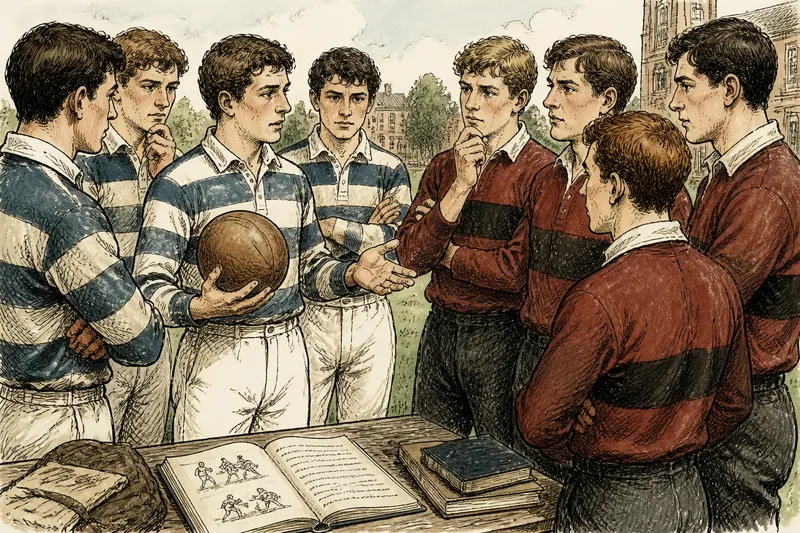
Rugby’s early rules are easier to understand if you start with a match between people who learned different versions of football. One team expects a runner to be tackled; the other expects handling to be restricted. Before play can begin, they have to decide which actions count. That practical problem—not a single dramatic moment—helps explain how rugby developed its distinct identity.
Accounts of the game’s early history often focus on Rugby School and William Webb Ellis. That tradition is part of rugby’s familiar origin story, but it does not by itself describe how rules took shape across schools and clubs. A more cautious overview follows the choices players and organizers faced: what handling meant, how contact worked, and whether communities could agree on a common code.
Why did local football rules matter?
In the early nineteenth century, football was not governed everywhere by one shared rulebook. Schools and clubs maintained local customs. Those customs could differ over handling, kicking, contact, the playing area and how play restarted. This is a general account of variation, not a claim that every school followed the same pattern or changed its rules in the same way.
Local rules could work perfectly well among players who had learned them together. They became harder to manage when unfamiliar teams met. A move one side considered legal could look like a breach to the other, much like two people trying to follow different instruction sheets for the same board game.
For a historical account, ask which school, club or rule set it describes. A specific setting is more informative than a sweeping claim about what “all football” allowed, especially when the account does not provide dates or name a particular rule change.
What did handling change about the game?
Allowing a player to carry the ball changes the choices available. The runner can advance, draw defenders or pass to a teammate. A game that emphasizes kicking puts more attention on striking the ball into space and contesting where it goes. Neither choice stands alone: each affects how players defend, make contact and restart play.
Even agreement that a player could handle the ball would leave more questions. Could the player run freely? Could the ball be passed forward? What could an opponent do to stop a runner? What happened when a player was brought down? To understand a rule, look at the actions it permits and the follow-on rules needed to make play workable.
Say two school teams arrive with different assumptions: one expects runners to be tackled, while the other expects players to kick the ball away before an advance. They agree before kickoff that carrying is allowed, but leave tackling and restarts unsettled. The agreement answers only part of the problem; if a runner is stopped, the teams still have no shared procedure for resuming play. Their next decision must address contact and the restart, or the same disagreement will interrupt the match again.
Why was a shared code difficult to agree on?
Rules do more than tidy up a match. They shape which skills matter and what players expect from one another. A community that valued running with the ball might regard handling as central to its game; another might prefer a code that restricted it. Choosing common rules could therefore mean setting aside customs that players considered essential.
Rules also traveled through people. Former pupils took familiar habits into clubs and universities, where they met players with different expectations. A broad agreement such as “handling is allowed” could leave too much unresolved. For a match to run, teams needed shared decisions about movement, contact, possession and restarts.
Organizers could retain local rules and accept that cross-community matches might be difficult, or try to establish a common code that not every group would accept. This general framing explains why divergence was possible without asserting a single meeting or moment as the cause of every later distinction.
How can you assess an account of rugby’s early rules?
- Check the setting. If an account names a school, club or code, then treat its claim as specific to that setting; if it generalizes without naming one, then look for a narrower source or qualify the claim.
- Check the action described. If the account says handling was permitted, then ask whether it also explains carrying or passing; if it does not, then avoid assuming those actions followed automatically.
- Check the contact rule. If tackling or stopping a runner is described, then note the stated condition; if contact is not addressed, then treat that part of the rules as unresolved.
- Check what happened after a stoppage. If a restart is specified, then include it in your account of play; if it is missing, then do not imply that teams already shared a procedure.
- Check the historical scope. If dates or named rule changes are provided, then use them to frame the claim; if they are absent, then present the account as a broad overview rather than a precise timeline.
- Check how tradition is presented. If the William Webb Ellis story is identified as a traditional account, then describe it as such; if it is presented as a complete explanation, then separate the legend from the wider process of rule-making.
Imagine a reader finds a school history that says pupils carried the ball, but it gives no date and says nothing about tackling or restarts. The reader records the claim as applying to that school’s account, leaves the date and missing rules open, and avoids treating it as proof that every school played the same way. The result is a narrower, more defensible description—not a complete timeline.
Which questions clarify rugby’s early rules?
Did one player invent rugby by picking up the ball?
The William Webb Ellis story belongs to rugby’s traditional origin account, but it cannot explain the full development of the game on its own. Local rules, shared play and later efforts to organize matches also matter.
Was carrying the only point of disagreement?
Handling was a significant issue, but it raised related questions about passing, contact, possession and restarts. A careful account distinguishes the rule about carrying from the other rules needed to govern a match.
Why did teams need agreed rules?
Players arriving from different schools or clubs could have different expectations about what was allowed. A shared code made matches more workable, though groups could still prefer different versions of football.
Did every community adopt one code at the same time?
It is safer to describe rule-making as a broader process than to claim that one agreement instantly replaced every local custom. The existence of differing preferences helps explain why distinct codes could persist.
What does the early split tell us about rugby?
Rugby’s early identity took shape through choices about how to handle the ball and how to organize the contest around it. Carrying matters, but it makes sense only alongside the rules for movement, contact and possession. The wider point is that a sport’s character can emerge from a connected set of decisions, not from one memorable anecdote.
When you read about rugby’s early rules, keep the scope visible: identify the setting, name the action being discussed, and note what the account leaves unanswered. That approach makes the history clearer without turning a general overview into a claim of certainty.