Scrum or Lineout: What Each Restart Sets in Motion
Scrum or lineout decisions shape the first contest after a stoppage. Learn what to watch in each formation and read the likely next move without assuming.
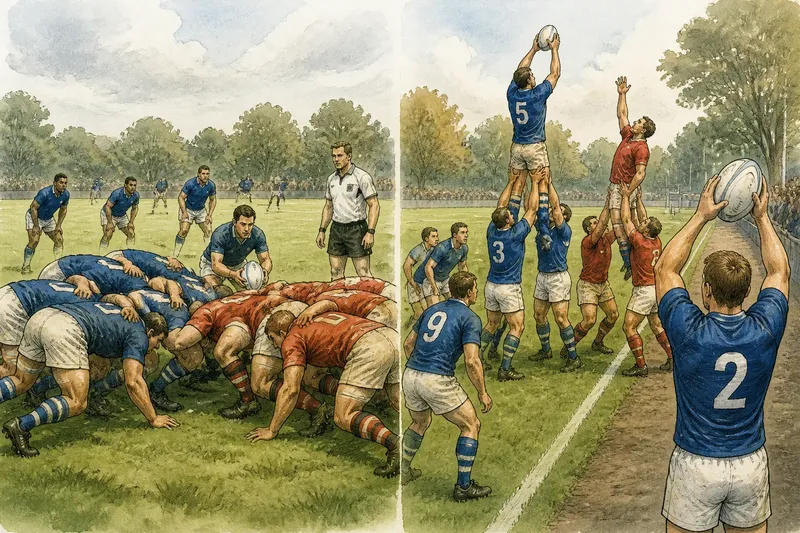
Scrum or lineout: what should you watch to read the next move? The reason play stopped usually determines the restart, and each formation creates a different first contest. A scrum binds the forwards into a compact group; a lineout arranges players in two lines beside touch. Neither formation tells you exactly what will happen, but both offer useful clues.
What does a scrum make possible?
A scrum restarts play after certain infringements, including a forward pass or knock-on, and in other situations set out in rugby’s laws. The forwards bind in opposing packs, and the scrum-half puts the ball in under the applicable laws. The teams then contest possession within the scrum. If the ball is secured and comes out cleanly, the team in possession can choose how to continue.
Watch the scrum-half and the backs, but treat their positions as clues rather than a forecast. The scrum-half may pass from the base, a forward may carry close to the pack, or the ball may emerge in a way that forces an improvised response. The available options depend on the scrum’s result, field position and defensive setup; the formation alone cannot tell you which side will control the ball.
A scrum concentrates players around the ball, while backs wait farther out. The defense must read the exit and cover the space beyond the pack, but pressure at the scrum can disrupt the attacking team’s intended play. Look for the put-in, the scrum-half’s position and whether the backs hold their width or move closer together.
What does a lineout make possible?
A lineout is one possible restart after the ball goes into touch; the exact outcome depends on how it got there and the relevant laws. Players form two lines beside the touchline, and a teammate throws the ball between them. The receiving team may use a jumper, lifters and coordinated movement to contest or secure possession. Height, timing and the throw’s accuracy shape this first contest.
After a catch, a team might pass to a back, give the ball to a nearby forward or form a maul if the laws permit and the players choose that option. A maul involves a ball carrier and bound teammates moving together against opposition. The touchline closes off one side of the field, so watch how the attack uses the space in front of it and where the defense positions itself.
The thrower’s target, the jumper’s movement and the scrum-half’s position can suggest a planned route. They do not settle the outcome: a contested catch, a defensive response or a disrupted throw can change the plan. Follow the ball after the catch to see whether play moves wide, stays close or develops into a maul.
What should you check before the ball moves?
- At a scrum, check who has the put-in. If the referee awards it to one team, watch that team’s scrum-half and backs for its intended exit; if possession is contested or the ball emerges awkwardly, expect the plan to change.
- At a scrum, check the backs’ spacing. If they hold their width, watch for a pass toward the outside; if they gather closer, watch for a shorter pass or a forward carrying near the pack.
- At a lineout, check the thrower’s target and the jumper’s movement. If they coordinate toward a spot, watch for a catch there; if the throw is contested or misses its target, follow the loose ball rather than assuming the planned move will proceed.
- At a lineout, check where support gathers after the catch. If teammates bind around the carrier, watch for a possible maul; if they spread out, watch for a pass or carry into open play.
- In either formation, check the defenders’ positions. If defenders close around the likely exit, expect the attack to face pressure there; if they leave room elsewhere, watch whether the attacking team tries to use that space.
- Check why play stopped before predicting the restart. If the referee signals a scrum, read the scrum formation; if the ball went into touch, wait for the referee’s decision because the outcome may depend on how it reached the sideline.
Say you are watching an invented match: the red team knocks the ball forward near the middle of the field, and the referee awards a scrum to its opponents, the blue team. Blue’s forwards bind, the blue scrum-half prepares to put the ball in, and the blue backs spread out. Those observations suggest a possible pass toward the backs if blue secures the ball, but they do not establish possession or guarantee that pass. If the defense disrupts the scrum, blue may need to react to the ball’s actual exit instead.
For the difference in shape, think of a closed umbrella beside an open one: the scrum packs bodies into one cluster, while the lineout stretches players along the sideline. The comparison is only about arrangement, not about what either team will achieve. In both cases, the players’ spacing hints at intent without settling the next action.
How do the laws affect which restart you see?
Does every ball into touch create a lineout?
No. The outcome can depend on how the ball reached touch and on the applicable laws, including what happened before it went out. For a particular match situation, the referee’s decision and the competition’s governing rules are the relevant references.
Can either team choose between a scrum and a lineout?
Usually, the event that stopped play determines the restart rather than giving teams a free choice between the two. Some situations provide options under the laws. Check the referee’s signal and the reason play stopped before interpreting the formation.
Does a lineout always lead to a maul?
No. After securing the ball, a team may pass, carry or continue in another legal way. A maul is one possible next contest, not an automatic result of a successful catch.
Is one restart always safer or more reliable?
Neither scrum nor lineout is inherently safer or more reliable in every situation. Each has different demands and risks, and players must follow the laws and the referee’s management. For a specific safety or legal question, ask a qualified rugby coach or referee.
How can you read the next action?
Start with the reason for the restart, then follow the first controlled touch of the ball. At a scrum, watch whether the ball stays close or the scrum-half releases it. At a lineout, track the catch, the support around the carrier and whether the ball leaves the touchline channel. A set piece is not merely a pause: it establishes a contest and presents choices that become visible as play resumes.
When you compare a scrum or lineout, focus on the first contest and the decisions that follow: the scrum’s bound forward contest, or the lineout’s throw and catch. Keep one distinction in mind: a formation suggests possible options, but possession and the defense’s response shape what actually happens. That is the most useful clue to carry into the next phase.