Your First Rugby Match: A Three-Phase Watching Plan
A first rugby match is easier to follow when you track one sequence from restart to tackle and the next phase, instead of chasing the score.
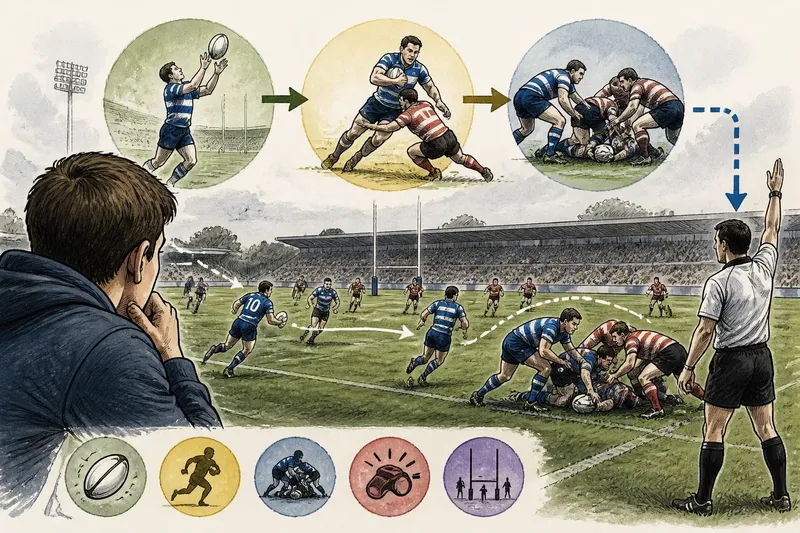
At your first rugby match, the ball can disappear beneath a cluster of players just as the crowd reacts. To follow the action, track one sequence from the restart through the first carry and tackle, then watch how play resumes. The score can wait; the ball’s route gives you a clear thread.
What should I watch first?
Start with the restart and the team receiving the ball. A kickoff or another restart puts play back in motion after a score or stoppage. The receiving side must decide how to gather the ball and what to do next.
Before the kick, note which team is restarting and which is receiving. As the ball travels, follow its landing area rather than trying to read every player at once. Ask three simple questions: who controls the ball, does that team keep it, and where does the next contest happen?
The receiver may catch the ball cleanly and carry it, or a teammate may gather a loose ball. Either way, open play resumes. If possession changes, shift your attention to the new carrier. The action may be heading in a different direction, but the ball remains your best guide.
How do I follow the first carry and tackle?
Watch the carrier’s route and the defenders closing in. The carrier may run toward a gap, angle toward a teammate, or pass before contact. Defenders try to stop forward progress and bring the carrier to ground. That moment gives you a useful marker in the sequence.
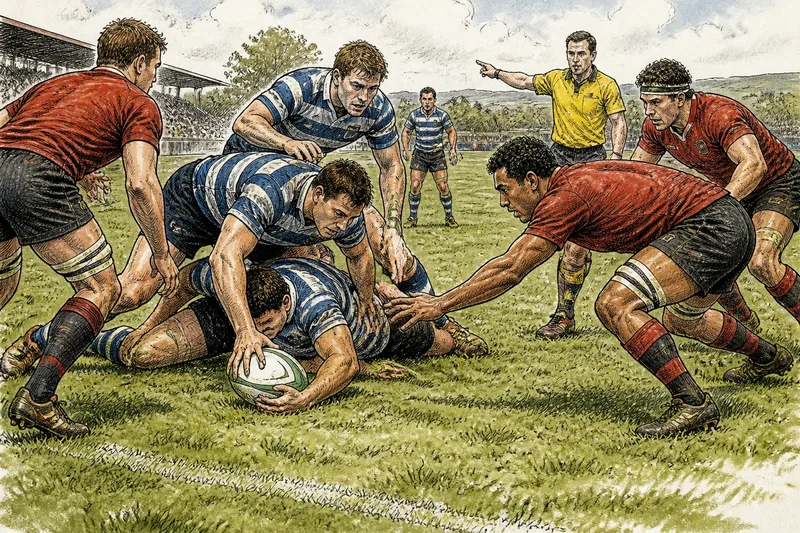
A tackle occurs when an opponent holds the ball carrier and brings them to ground, or otherwise makes them go to ground while held, subject to the laws. Not every fall is a tackle, and the exact ruling depends on what happened. For a newcomer, a stopped carrier followed by players gathering around the ball is a cue that play has reached a new contest.
Notice how the two sides approach. The carrier’s teammates may arrive to protect access to the ball, while defenders may try to compete for it. You do not need to identify every role or judge each action. Keep track of the ball’s location, which side seems able to play it, and whether the referee lets play continue.
Say the receiving team catches a restart and runs toward the near touchline. A defender brings the carrier down, and teammates gather over the ball. Watch for the observable outcome: the original team may retain possession and continue, the other team may gain the ball, or the referee may stop play. That result tells you which team to follow next.
What does a new phase actually mean?
A phase is one passage of open play, often ending when a carrier is tackled and the teams contest the ball. If the attack retains possession, play can restart from that contest and form another phase. The phases are separate passages within a longer sequence, not simply everything that happens after the tackle contest.
Think of each phase as one link in a chain. After a tackle contest, look for the pass or pickup that sends the ball back into open play, then follow the next carrier. Ask whether the attack advances, moves sideways, or turns back to keep possession. Those clues make the flow easier to read without memorizing every law.
Listen for the referee, too. A whistle stops play; the referee’s decision determines what happens next. If you hear one, look for the signal and the ensuing restart rather than guessing from the crowd’s reaction. The restart depends on the event and the applicable laws.
How can I stay oriented when play gets messy?
Use three anchors: the ball, the team that appears to have possession, and the referee. When players obscure the ball, shift your attention to the open space around the contest. The next pass, pickup, kick, or referee signal will usually clarify how play is continuing.
The touchline is another helpful reference. It marks the edge of the field, so a carrier moving toward it has less room in that direction. A kick may send play downfield, but it does not automatically mean a turnover: the kicking team may be contesting the ball, seeking territory, or responding to pressure. Watch who gathers it and follow that side.
- Before the restart: Check which team is kicking and which is receiving. If you identify both, follow the receiving team’s first move; if you cannot, watch the ball’s landing area and identify the first player who controls it.
- At the catch: Check whether a player controls the ball. If the catch is clean, follow that carrier; if the ball is loose, wait for a player to gather it before deciding which side to track.
- On the run: Check where defenders close in. If the carrier has room, watch the route; if defenders make contact, turn your attention to the tackle and the ball contest that follows.
- At the contest: Check which side can play the ball onward. If one team retains possession, follow its next pass or pickup; if possession changes or the referee stops play, follow the new team or the referee’s restart decision.
- After the ball is played onward: Check whether a pass or pickup begins another passage of open play. If it does, follow the new carrier; if the ball is kicked or play stops, watch where it goes and what the referee signals.
- At a whistle: Check the referee’s signal. If it indicates a stoppage, look for the restart and identify which team will put the ball back into play; if play continues, return your attention to the carrier.
This is a viewing aid, not a substitute for the laws. Details can vary by competition and situation; where a ruling matters, the referee’s decision and the applicable competition rules are the guides.
Why follow the play instead of only the score?
The score records what has happened; a sequence shows how the teams are shaping play. One team may be behind yet keep possession through several phases, while another may lead but struggle to retain the ball. Following a restart and the passages that follow lets you notice those choices as they happen.
It also gives you a way to rejoin the match after a distraction. Find the ball, identify the team that has it, and watch for the next carry, kick, or stoppage. You do not need to reconstruct every earlier event. The next clear action gives you a fresh starting point.
What should I notice in the next passage?
Once you can follow one sequence, compare it with the next. Does the receiving team carry the ball or kick it? Does the first carrier find open space or meet a line of defenders? After a tackle, does the attack play the ball onward quickly or gather before continuing? These observations help explain why one passage builds while another ends in a stoppage or a change of possession.
For your first rugby match, this simple viewing plan keeps your attention on the action: watch the restart, follow the first carry and tackle, then look for how the next passage begins. Keep an eye on the score when it changes, but use the ball’s movement to understand what happens between those moments. When the action becomes difficult to see, find the next clear pass, pickup, kick, or referee signal and use it to reorient yourself.